German Electricity Bills Explained: Every Line, Decoded
By
Hermann Furin
27.8.2026

German Electricity Bills Explained: Every Line, Decoded
Your first German Stromrechnung is a two-page PDF with about forty numbers on it, most of them in German, and one line at the bottom saying you owe 340,00 EUR.
Here's how to read it, and how to spot when something is wrong.
At a glance
- Every German tariff has exactly two price components: a base price and a unit price
- Your monthly payment is an estimate, not a bill
- Around 34 % of a German electricity price in 2026 is state-set taxes, levies, and charges
- Grid fees are identical across every provider at your address
- Always check your meter number, your opening meter reading, and the billing period
The two prices you actually pay
Every German electricity tariff has exactly two price components.
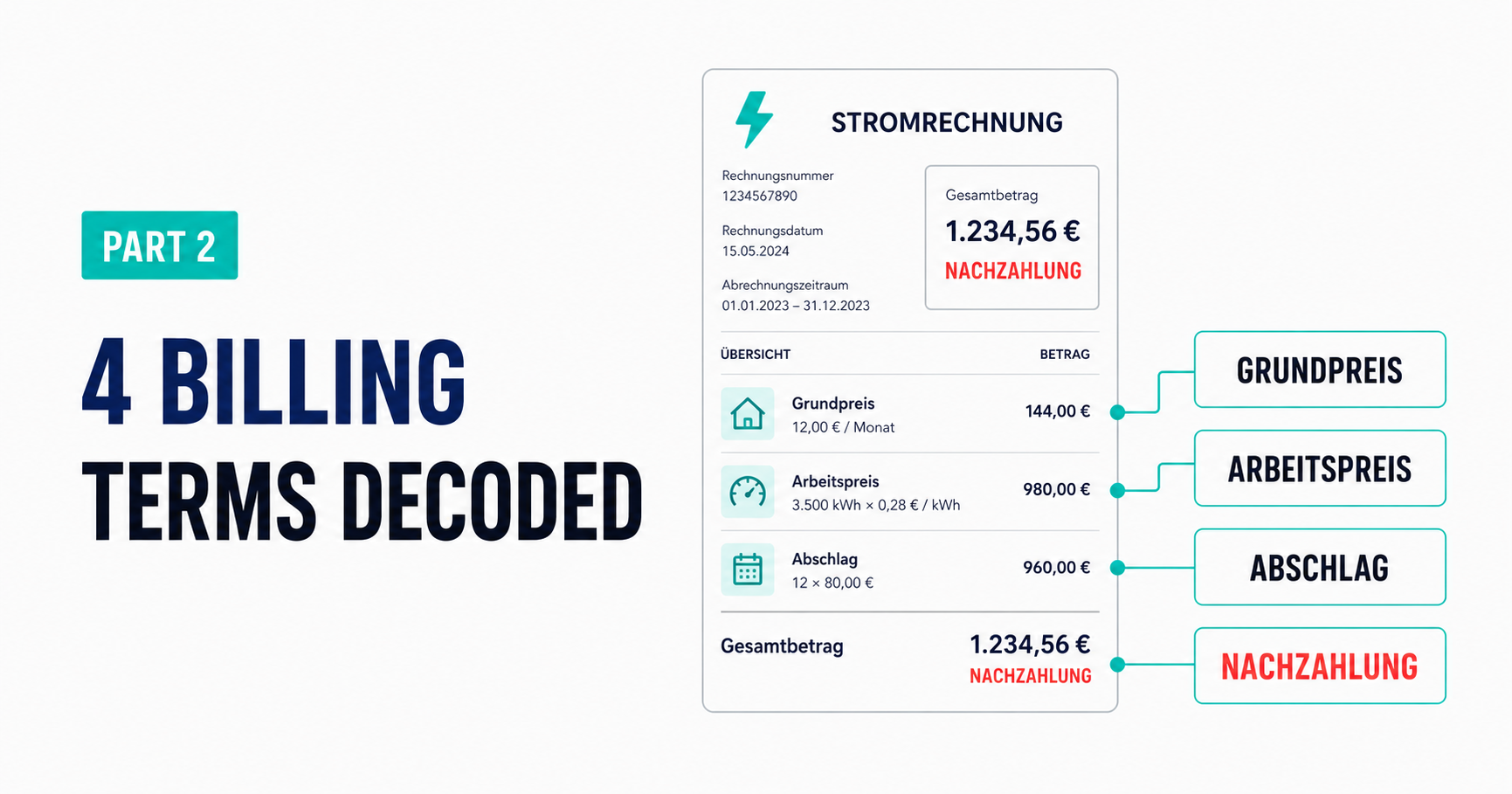
Grundpreis (base price). A fixed monthly or yearly fee. You pay it whether you use electricity or not. Typically 8,00 EUR to 15,00 EUR a month for a household.
Arbeitspreis (unit price). What you pay per kilowatt-hour used, in cents. This is the number every comparison site shows.
Your yearly cost = (base price × 12) + (kWh used × unit price).
That's it. A tariff with a low kWh price and a high base price can easily cost more than the reverse if you use little electricity. Always run the math on your own consumption.
Where your money actually goes
Around 34 % of a German electricity price in 2026 is state-set taxes, levies, and charges. You don't get to negotiate that part with anyone.
| Block | What's in it | Negotiable? |
|---|---|---|
| Procurement and sales | What your provider pays for the electricity, plus operating cost and margin | Yes. The only part providers genuinely compete on |
| Grid fees (Netzentgelte) | The poles, cables, transformers, and meter that deliver your electricity | No. Set by your grid operator, regulated by the Bundesnetzagentur. Identical for every provider at your address |
| Taxes and levies | 19 % VAT, electricity tax at 2,05 ct/kWh, concession fee, KWKG levy, §19 StromNEV levy, offshore grid levy | No |
Why this matters: when a provider explains a price increase with "rising costs", check whether grid fees or levies actually moved. Those changes hit every provider at the same time.
Abschlag: the monthly payment that isn't your bill
This trips up nearly every new arrival.
You don't pay for the electricity you used last month. You pay a Monthly Deposit (Abschlag), an estimated monthly amount based on a forecast annual consumption. Once a year your provider reads your actual meter and settles up.
- Used less than forecast? You get a refund (Guthaben).
- Used more? You owe the difference (Nachzahlung).
For a first-time renter with no consumption history, that forecast is a guess based on apartment size and household size. Guesses are often wrong.
What to do: check your actual consumption after three months. If you're tracking well above forecast, raise your deposit yourself. A 40,00 EUR increase across nine months is much easier than a 400,00 EUR bill in month twelve.
In the Ostrom App you change your Monthly Deposit yourself, any time. No email, no phone call.
Your annual bill, line by line
Zählernummer. Your meter's ID. Check it matches the number on your physical meter. If it doesn't, you may be paying for someone else's consumption.
Zählerstand alt / neu. Meter reading at the start and end of the billing period. The difference is your consumption. Compare "alt" against the photo you took on move-in day.
Verbrauch in kWh. Total used. Sanity check: a one-person apartment typically lands around 1,500 to 2,000 kWh a year, a two-person household around 2,500 to 3,000 kWh. Three times that means something is off, or you have electric heating.
Abrechnungszeitraum. The billing period. Should not exceed twelve months.
Grundpreis and Arbeitspreis. Check they match your contract. If your price changed mid-period, you'll see two blocks with different rates and dates.
Bereits gezahlte Abschläge. Total deposits you already paid. Should equal your monthly amount × number of months.
Nachzahlung or Guthaben. The settlement. Consumption cost minus deposits paid.
Neuer Abschlag. Your new monthly amount for next year, based on last year's actual use. Usually more accurate than the first estimate.
Netzbetreiber. Your grid operator. This is who you call if the power fails or the meter is broken.
Common billing problems, and what to do
"Geschätzter Zählerstand". Your reading was estimated, not measured. Legal, common, and often wrong. Read your meter, send the actual number, ask for a corrected bill.
Bill covers more than twelve months. Ask for a corrected settlement, split by period.
Consumption jumped with no lifestyle change. Check for a fridge or freezer older than ten years, an electric boiler, an aquarium, a tumble dryer. In older buildings, mislabeled meters also happen, which means you're paying for a neighbor.
You're billed from before your move-in date. Send your move-in reading photo and your rental contract. This is the single best argument for photographing the meter on day one.
How to actually lower the bill
Two levers: your price and your consumption.
Price. Compare on Check24 or Verivox, but read the fine print on bonuses and contract length. Switching is free, takes at most three weeks, and never interrupts your supply.
Consumption. The biggest single wins in a German apartment are usually a fridge older than ten years, an electric water heater on a timer that no longer matches your life, and standby draw on a media setup. Hourly data helps you find them. With a smart meter and SimplyDynamic you can also shift heavy loads like laundry and dishwashing into cheaper hours.
FAQ
How often do I get a bill?
One annual settlement, plus your monthly deposit. Some providers offer monthly statements. In the Ostrom App you see your consumption and cost as it accrues.
Can I pay by credit card?
Most German providers use SEPA direct debit only. Some accept bank transfer. Credit card is uncommon.
What if I can't pay a Nachzahlung?
Contact your provider before the due date and ask for an installment plan (Ratenzahlung). Most agree. Ignoring it leads to reminder fees and, eventually, disconnection notices.
Do I get money back if I move out mid-year?
Yes. You get a final settlement (Schlussrechnung) based on your move-out reading. Overpayments come back to you.
Why is my base price higher than my neighbor's?
Different tariff, or a different grid fee zone if you're in different buildings. Grid fees vary a lot across Germany.
Do I pay VAT on the whole bill?
Yes, 19 % applies on top of everything else, including the other taxes and levies.


Green Energy Made Easy
Switch and save in only 5 minutes