Green Energy Made Easy
Switch and save in only 5 minutes!
Thank you! Your submission has been received!
Oops! Something went wrong while submitting the form.
Energy
By
Ostrom Team
9.4.2026

5
Min.
You chose a 100% renewable electricity tariff. Yet your bill can still rise when gas gets more expensive across Europe. At first glance, that feels contradictory.
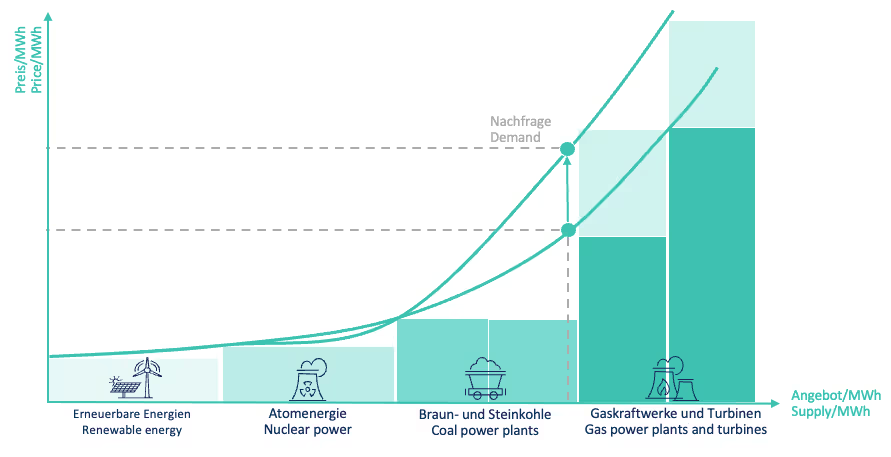
The simple answer is this: The cheapest power plant does not set the market price. The most expensive plant still needed does. And that is often gas.
💡In short
Yes, you are on a renewable tariff. Your supplier makes sure that for every kilowatt-hour you use, the same amount of electricity from renewable sources is fed into the grid. This is verified through certificates.
But that does not mean your electricity travels a separate path. All electricity from wind, solar, coal, and gas flows into the same grid and is delivered through the same system. Your tariff determines how your consumption is matched with green generation on paper. The wholesale market determines what electricity costs in any given hour.
That is why two things can be true at the same time:
So if a gas plant is still needed in a given hour to meet demand, that gas plant can pull the market price up. That often flows through to your bill.
The market follows one simple rule: The most expensive power plant still needed sets the price for all electricity.
This ranking of plants by cost is called the merit order.
Imagine the market needs three power plants for one hour:
But wind and solar alone are not enough in that hour, so the gas plant is still needed.
Result: The market price is not 20 € or 30 €. It is 90 €/MWh. Even the wind farm gets 90 €/MWh because the last plant still needed sets the price for everyone.
More precisely, the merit order describes short-term wholesale price formation: generators bid roughly at their short-run marginal cost, mainly driven by fuel, CO₂, and variable operating costs, and in day-ahead or intraday markets there is usually a uniform clearing price, meaning the last plant still needed sets the price for all accepted generation.
Gas is often price-setting because gas plants are flexible and their marginal costs tend to be relatively high once fuel and carbon costs are included. But two nuances matter: gas does not set the price in every hour, only when it is actually needed on the margin, and the final retail bill depends not only on wholesale prices, but also on procurement, grid fees, taxes, and levies.
The merit order effect of renewables: Wind and solar plants have near-zero marginal costs because they have no fuel expenses. The more they feed in, the further they push expensive gas plants back in the dispatch order. The energy industry calls this the merit order effect (MOE) – and it is the reason prices can drop so sharply in sunny and windy hours.
The missing-money problem: Gas plants that rarely run struggle to cover their fixed costs. This creates an investment risk: the very flexible capacity the grid needs as backup becomes economically unattractive.
A real-world example – the 2021/22 energy crisis: When gas prices surged following Russia's invasion of Ukraine, gas plants drove wholesale electricity prices to extreme highs – even though wind and solar were producing just as cheaply as before. The merit order principle made this crisis felt directly by millions of households.
Yes. If you have a 100% renewable tariff, your supplier makes sure that for every kilowatt-hour you use, the same amount of electricity from renewable sources is fed into the grid. This is verified through certificates.
What this does not mean: Electricity does not flow directly from a wind turbine to your home. That is simply not how the grid works. Instead, all electricity is fed into the grid together and distributed, regardless of whether it comes from wind, solar, or other sources.
Not every country feels this effect to the same degree.
Electricity becomes meaningfully less tied to gas only when wind, solar, and other low-cost sources are sufficient in a large number of hours to meet demand without extra gas.
Electricity prices only become noticeably less dependent on gas when wind, solar, and other low-cost sources can meet demand in many hours without additional gas.
Germany is moving in that direction, but not far enough yet for gas to stop shaping prices on a sustained basis.
The same market rule that pushes prices up in some hours pushes them sharply down in others. When the grid is full of wind and solar, prices often fall a lot. That is where dynamic tariffs become interesting. With a fixed tariff, you pay an average price for certainty. With a dynamic tariff, you can make use of cheaper hours.
In the Ostrom app, you can see next-day prices in advance. This helps you plan your usage and shift demand into cheaper hours: midday when solar is strong, windy hours, or times when your EV can smart charge automatically.
Lastly, with our integrations for over 1,400 home energy management devices and NeoGrid® AI help you keep your energy use under control in your daily life.







.avif)